Some U.S. taxpayers may receive extra refunds in 2026, with estimates suggesting about $1,000 more for certain filers, according to government officials and independent analysts.

The projected increase reflects recent tax law changes combined with delayed payroll withholding adjustments, rather than new stimulus payments or across-the-board tax cuts.
Taxpayers May See $1,000 More
| Key Fact | Detail |
|---|---|
| Tax year involved | 2025 income |
| Filing season | Early 2026 |
| Estimated increase | ~$1,000 for some filers |
| Primary driver | Over-withholding |
| Universal benefit? | No |
The Core Question: Why Extra Refunds in 2026?
The possibility of extra refunds in 2026 stems from how the U.S. tax system collects income taxes throughout the year. Most Americans pay federal income tax through automatic withholding from wages. Employers rely on IRS tables to estimate how much tax workers owe annually.
When tax laws change after a year has begun, those tables may not immediately reflect the new rules. As a result, many taxpayers continue paying taxes based on outdated assumptions, even if their final tax liability is lower. When returns are filed, the overpayment appears as a refund.
A Timeline: How 2025 Tax Provisions Becomes 2026 Refunds
- Law changes during 2025: Several tax provisions affecting deductions and credits were adjusted or extended partway through the year.
- Payroll systems lag: Employers did not uniformly update withholding formulas in real time.
- Taxes withheld exceed liability: Workers unknowingly pay more tax per paycheck than required.
- Filing season reveals the gap: Refunds issued in early 2026 reflect the accumulated overpayment.
“This timing mismatch is the whole story,” said a former Treasury Department tax policy adviser. “Nothing extraordinary has to happen.”
Refunds vs. Tax Cuts: A Crucial Distinction
Economists stress that a larger refund does not automatically mean a larger tax cut. A refund represents money already earned and paid to the government earlier than necessary. A tax cut reduces the total amount owed.
“If your refund goes up, your take-home pay went down during the year,” said a certified public accountant in Ohio. “It’s a cash-flow issue.”
What Tax Law Changes Contributed
Recent legislation modified several provisions that reduce taxable income or increase credits. These include:
- Adjustments to the standard deduction
- Expanded or extended family-related credits
- Targeted exclusions for certain categories of earnings
Because these provisions applied retroactively to parts of 2025, withholding systems did not capture their full effect in real time.
Who Is Most Likely to See About $1,000 More
Analysts say the biggest increases are likely among:
- Lower- and middle-income wage earners
- Households with children eligible for credits
- Workers with overtime or variable income
- Employees who did not adjust Form W-4
By contrast, self-employed taxpayers and high-income filers who manage estimated payments are less likely to see a significant increase.
Why the “Average” Can Be Misleading
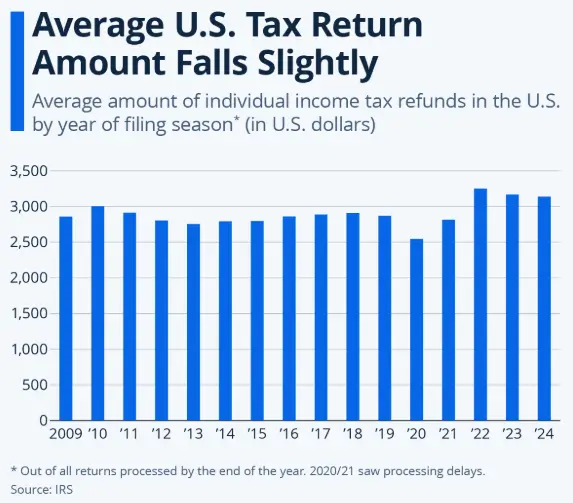
The projected $1,000 figure reflects an average, not a guarantee. Some taxpayers may receive refunds several thousand dollars higher than usual, while others see little change. Averages are pulled upward by larger refunds among specific groups. Tax professionals caution against planning household finances around headline numbers.
Historical Context: This Pattern Is Familiar
Refund increases following tax law changes have occurred before. After reforms in 2001, 2008, and 2017, IRS data showed temporary spikes in average refunds. In each case, refunds normalized once withholding tables were updated and taxpayers adjusted elections.
“This is not a one-off phenomenon,” said a senior fellow at a nonpartisan tax policy center. “It’s how the system behaves.”
IRS Operations and Refund Timing
The Internal Revenue Service processes millions of refunds each filing season. Larger average refunds do not necessarily mean faster refunds. In fact, higher refund volumes can trigger additional fraud screening, especially for returns claiming credits.
That can slow processing for some filers.IRS officials continue to advise early filing and direct deposit to reduce delays.
Common Myths and Misinformation
The prospect of larger refunds has fueled misleading online claims suggesting “bonus refunds” or “extra payments.” Those claims are inaccurate. There is no separate refund program and no entitlement beyond standard tax calculations. Any increase will come only through the normal filing process.
What Taxpayers Can Do Now
Experts recommend several proactive steps:
- Review withholding using IRS calculators
- Adjust Form W-4 if paychecks feel too tight
- Track life changes such as marriage or dependents
- File early to avoid refund delays
Some taxpayers prefer large refunds as forced savings. Others prefer higher monthly income. Both are valid choices.
Broader Economic Effects
Economists expect modest consumer spending increases during refund season in early 2026. Refunds often fund debt payments, savings, or major purchases. However, because refunds represent delayed income, analysts do not expect significant inflationary effects. “It’s a timing shift, not new demand,” said a labor economist at a public university.
Related Links
Six More States Approved to Restrict Certain Foods Under SNAP Waiver Program – Check Details
Pennsylvania Reopens Refund Window for Renters and Homeowners — How to Apply?
Looking Ahead
Early IRS refund data, usually released in February, will indicate whether projections hold. Most experts expect any increase to be temporary, fading as withholding systems adjust. For now, the key takeaway is clarity: extra refunds in 2026 are possible for some taxpayers, but they reflect timing mechanics, not windfalls.
FAQs About Extra Refunds in 2026
Is everyone getting $1,000 more?
No. The figure is an average estimate.
Is this a stimulus payment?
No. Refunds reflect over-withholding.
Will refunds stay higher long-term?
Most experts expect normalization.