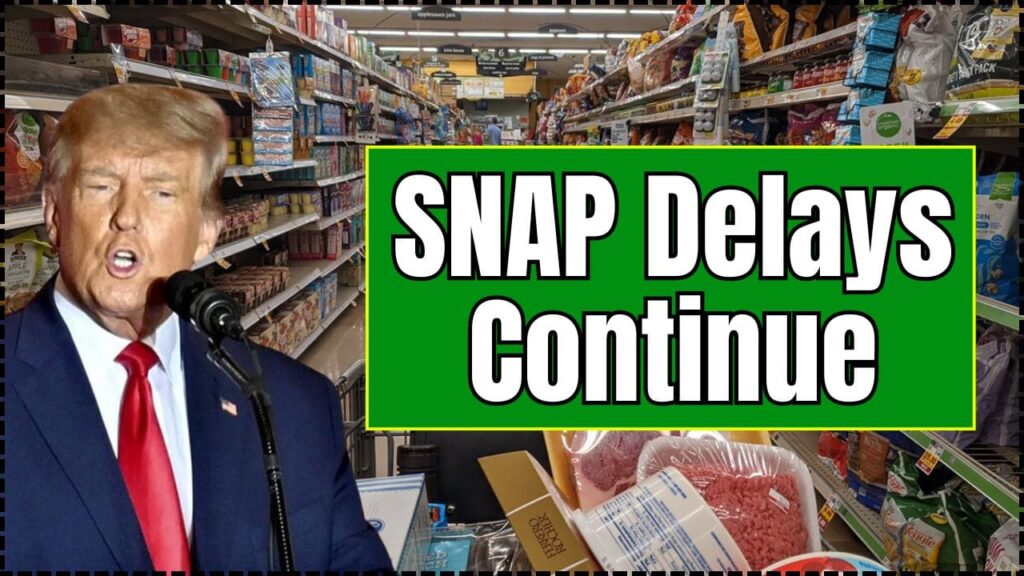
Millions of low-income Americans continue to face SNAP delays weeks after federal courts ordered the U.S. Department of Agriculture (USDA) to resume benefits halted during the 2025 government shutdown. State agencies report technical setbacks, legal uncertainty, and partial federal funding as key obstacles to fully restoring assistance, leaving more than 42 million people unsure when they will receive essential food aid.
SNAP Delays
| Key Fact | Detail / Statistic |
|---|---|
| Americans relying on SNAP | ~42 million |
| Full benefits froze | Late October 2025 |
| Initial court orders | October 31, 2025 |
| Emergency stay issued | November 7, 2025 |
| Partial funding released | ~$5.25 billion |
While many states have made progress in clearing their backlogs, advocates warn that recurring shutdowns or legal uncertainties could disrupt benefits again. Some lawmakers plan to introduce legislation to shield nutrition programs from future political battles, though it remains unclear whether Congress will pursue long-term reforms.
What Caused the SNAP Delays?
The delays stem from a combination of shutdown-related funding freezes, legal disputes, and the limited availability of federal contingency funds.
Shutdown Led to Immediate Funding Halt
When the federal government shut down in late October 2025, the USDA announced that November SNAP benefits could not be issued because Congress had not approved new spending. The Supplemental Nutrition Assistance Program (SNAP), responsible for helping low-income households buy groceries, is one of the largest safety-net programs in the country and relies on monthly congressional appropriations.
The USDA initially stated that states could use a limited contingency fund, but advocates noted that this reserve covered only a fraction of monthly program costs.
Court Orders Sought to Force Funding Restoration
In response to multiple lawsuits filed by states and advocacy groups, federal judges in Massachusetts and Rhode Island ordered the USDA on October 31 to resume SNAP payments immediately. The rulings found that the government had both the legal authority and responsibility to use emergency funding to avoid widespread hunger.
One judge wrote that the “risk of irreparable harm to millions of Americans” outweighed the administration’s budgetary constraints.
Supreme Court Intervention Added New Confusion
Only days later, the U.S. Supreme Court issued an administrative stay to allow the 1st Circuit Court of Appeals to review the case. This brief stay threw states into uncertainty about whether full benefits should continue, pause, or be recalculated—contributing to the SNAP delays still unfolding.
Why Payments Remain Delayed Across Many States
Despite court orders and partial funding restorations, states have struggled to distribute benefits. The reasons vary, but several common challenges have emerged.
Limited Funding Has Slowed Full Restorations
The USDA released roughly $5.25 billion in contingency funds—enough for partial payments, not the full monthly allotment. Several states began preparing for reduced disbursements, only to reverse course after subsequent legal updates.
State SNAP directors have reported confusion about whether to resume full or partial benefits. Some states issued full benefits on November 7, only to receive guidance hours later instructing them to reverse payments if possible.
Outdated Technical Systems Create Processing Backlogs
Many states rely on aging software and Electronic Benefit Transfer (EBT) systems that are not built for rapid recalibration. Some states cannot easily issue partial benefits or make mid-month corrections.
EBT vendors have warned that processing reversals, reissued benefits, or recalculations could take days or weeks. Several states have stated publicly that they lack the capacity to retroactively track and adjust payments at scale.
Contractual Limitations Slow Emergency Processing
Some states attempted to use local emergency funds to cover gaps but faced procurement and contracting restrictions. For example, some agencies reported that vendor agreements prohibited the processing of emergency food benefits without federal authorization—delaying any independent action.
The Human Toll of Ongoing SNAP Delays
The failure to deliver timely benefits has had profound effects on families and communities, especially those living paycheck to paycheck.
Food Insecurity Rising in Affected States
Advocates and food banks have documented sharp increases in food assistance requests. Many families depleted their October benefits by early November and have no reliable timeline for receiving aid.
Food banks in several major cities reported demand rising by 20–35 percent since the shutdown began. Volunteers note that many first-time visitors cite SNAP delays as the reason for seeking help.
Children and Older Adults Particularly at Risk
Nearly half of SNAP participants are children. Another significant share are older adults or people with disabilities. Even small delays can force these groups to skip meals or ration food.
A social policy researcher from a major Midwestern university told reporters:
“When delays occur in a program as essential as SNAP, the consequences show up almost immediately—especially for families with young children.”
Retailers Are Feeling the Strain Too
Grocery stores that rely on SNAP transactions report decreases in foot traffic and increased uncertainty about demand forecasting. Smaller retailers in rural areas have raised alarms about cash-flow challenges, saying that prolonged delays could threaten their viability.
The Legal Battles Behind the Delays
Multiple Cases Across Several Federal Courts
States have filed suits in at least three federal districts, arguing that the USDA is required to continue issuing benefits during shutdowns. Different judges issued varying orders, leading to conflicting interpretations.
Appeals Court Decisions Are Still Ongoing
The 1st Circuit Court of Appeals heard arguments in early November. While the court allowed some lower-court rulings to remain in effect, its decisions have not resolved the broader question of whether the USDA must issue full benefits during extended shutdowns.
Legal experts say a Supreme Court ruling may ultimately be required, and uncertainty will likely persist until that happens.
Broader Policy Questions Raised by the Crisis
Should SNAP Be Shielded from Shutdowns?
Policy analysts have renewed calls for Congress to classify SNAP as a mandatory entitlement with protected funding. Under current rules, only limited reserves are available during a shutdown.
A senior fellow at a national think tank said:
“SNAP delays show how vulnerable our safety-net programs are when political negotiations break down. The scale of the program demands more stable funding mechanisms.”
Calls for Modernizing State EBT Systems
The crisis has also revealed how deeply reliant states are on a few private EBT vendors. Upgrading these systems could help prevent delays during emergencies, but modernization requires substantial investment.
Debate Over USDA’s Interpretation of Shutdown Law
Critics argue that the USDA misinterpreted its legal authority, leading to unnecessary hardship. The agency insists that it acted within the constraints imposed by federal shutdown rules.
What States Are Doing Now
Some States Have Fully Disbursed Benefits
States with flexible EBT systems and clearer early guidance have successfully issued November benefits. These states transitioned quickly after the court orders and did not reverse course during the Supreme Court’s administrative stay.
Other States Still Processing Partial or Delayed Payments
Many states in the South and Midwest remain weeks behind schedule due to funding and technical issues. Officials have publicly warned that the recalculation and issuance process could extend into late November or beyond.
2026 Social Security Notices Coming Soon — Key Benefit Changes to Look For
Emergency Food Programs Activated
Several states have activated National Guard units to assist with food distribution logistics. Local charities have increased hours, expanded mobile distribution sites, and launched emergency fundraising campaigns.
How the Federal Government Is Responding
Shutdown Ended, But Backlogs Remain
Congress has approved temporary funding to reopen the government, and the USDA has begun allocating money for the coming months. However, the backlog of unprocessed November payments persists.
USDA Working on Updated Guidance
Agency officials say they are preparing standardized instructions for all states. The goal is to eliminate conflicting interpretations that contributed to the delays.
Long-Term Fixes Under Discussion
Lawmakers from both parties have expressed interest in preventing future disruptions. Proposed ideas include:
- Permanent rollover funding authority
- Automatic contingency funding increases
- Protections for essential nutrition programs